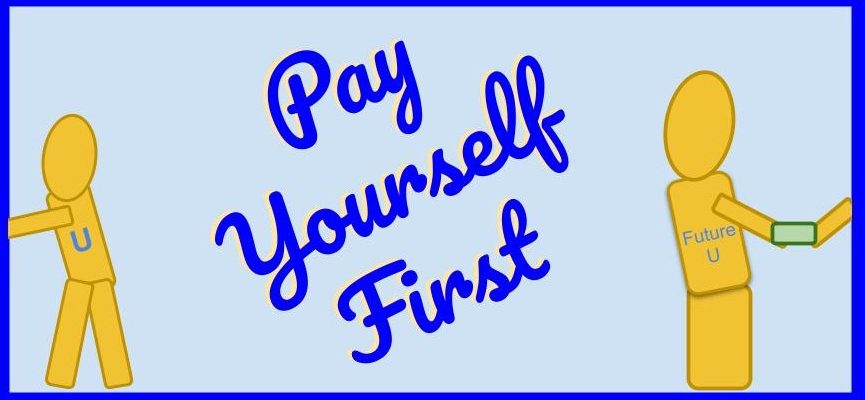
Any saving strategy, investment, or opportunity requires something more basic: cash. To have any cash to put into investments, you have to follow our first rule for early retirement: Pay Yourself First.
This concept is a classic and George S. Clayton uses it as a fundamental principle for success within the The Richest Man in Babylon. This book, published in 1926, has other advice that is useful and everyone should read it.
However, the most critical point for today’s purposes is that you should never spend all of your income. Instead start saving at least 10% of everything earned and put it to work for your future.
Live Within Your Means
Saving will be the hardest when you need most of your income to cover expenses. However, to grow your wealth, you must create fuel – in other words, you need to set aside some cash.
In the future, you can work hard and possibly earn promotions or a raise. Until then, the easiest lever to pull will be to reduce expenses. The easiest expenses to control are unnecessary fees, debt expenses, and luxuries.
Unnecessary Fees
Banks, credit card companies, tax authorities, and others issue fees as penalties. Set up autopay on utilities and credit card bills so that you never have to deal with late fees. Also manage expenses so you don’t have to deal with overdraft charges or minimum balance charges.
In my youth, I used to have an account at Bank of America, but one day, I checked my statement and found that my $700 paycheck deposit occurred the same day as my $650 rent check and my ending balance was $1,600.
However, the bank selected to process the payment first so that it would trigger a $25 minimum balance fee for dropping below $1,000! How convenient for them. The very next week, I switched to USAA Bank, an online bank with no minimum balance requirement and a better interest rate.
I also had a bad habit of speeding. Once my kids were born, the increasing costs of speeding tickets and traffic schools became too painful, so I had to slow down a lot. While this surely improved my personal safety, the financial pain of the unnecessary traffic fines provided my primary motivation.
Debt Expenses
Some debt may be useful. Loans for cars, homes, and school make big purchases possible and can open opportunities to increase your income or to control future expenses.
However, if you lose track of your loan amounts, especially for credit card debt, you can easily wind up in a situation where your debts become crushing. Ideally, your debt is a tool to benefit you, not one to destroy your future.
Since we became a couple, my wife and I never carried a credit card balance. We paid off the full amount every month to avoid unnecessary interest payments. We did keep student loan balances because I had managed to score a sweet loan interest rate under 2%!
Our home loans were a different story and started out around 10.5%. As soon as we could, we refinanced to 8% and always looked for opportunities to reduce this cost. We even “paid ourselves first” by adding extra to every home loan payment so we could pay off the loan faster.
Luxuries
Paying yourself first still allows you to have fun. But it might mean picking and choosing more carefully.
I really enjoyed Cherry Coke throughout my school years and drank one almost every day. However, I gave up soda when I was working on a start-up company for almost a year.
By the time I had a celebratory soda, it was gross and was like sucking on maple syrup! When you give up some luxury items, you may find that you don’t really need them and you can save money – and in the case of my soda habit, also improve your health…
Our family always loved food, but eating out was too expensive. For roughly the first ten years of our kids’ lives, we tried to limit going out to eat (even fast food) to once a month.
We tried to make it educational and broaden their horizons by introducing a different country’s ethnic food every month. Unfortunately, that ambition failed miserably, because after Japan and Italy, the kids never wanted anything but ramen and spaghetti! You win some, you lose some.
Our choices also involved selecting lower-cost options or doubling up on objectives. For example, we enjoyed a multi-year membership to the LA Zoo instead of Disneyland and we incorporated kids activities into mini family vacations.
Some worked better than others. Even though my eldest daughter hated Judo, she joined her siblings in enjoying the trip out to Disney World despite the judo tournament.
Then there was the disastrous trip to the San Gabriel Mission for my son’s 4th grade mission project where he threw up all over the car as we pulled into the parking lot… We had to turn around and go home instead of enjoying the mission and a restaurant.
Unexciting Success
Despite breathless YouTube video titles to the contrary, there really are no secrets to retirement. Everyone can succeed by following simple, although quite unexciting rules.
Paying yourself first and living within a budget is both the most boring rule and also the most critical. Eventually, we’ll talk about how to make that cash grow and become useful. For now, just focus on this perspective: every dollar saved today is a dollar you are paying to your future self.
Your future self may have medical emergencies, want to buy a house, or simply be able to walk away from a bad job. You don’t need a specific reason, simply understand that money provides options and is often more useful to you in the future than it might be right now.
[…] starting to Pay Yourself First, cash starts to accumulate. That is when we Put Our Money to Work (our rule for early retirement […]
[…] start. This will probably be the first time that you begin to pay yourself first, so you just need to start somewhere and save what you can – $100 or even $10 a month is a […]
[…] to be completely debt free. Owing money to anyone else forces you to pay them money before you can pay yourself and out of control debt can wreck your financial […]