A few years back, I asked someone very dear to me how they were investing the money they put into their individual retirement account (IRA). After a momentary blank stare, they replied “I put the money into a Roth IRA.”
“That’s great,” I replied, “but then what did you buy with that money in your Roth IRA?” After a pause and a confused look, they said “what do you mean?”
I then had to go on to explain that an account is a container for investments. The deposited cash still needed to be invested into something!
For experienced investors, this might be funny because it seems so basic. However, the most basic concepts often will be hard to understand or simply overlooked by inexperienced investors – and just as easily overlooked by experienced investors who fail to even think about teaching it!
Let’s fix that right now. This short article covers the basic differences between funding and investing and then summarizes recent research illustrating how this common issue potentially affects millions of investors.
Basic Differences Between Funding and Investing
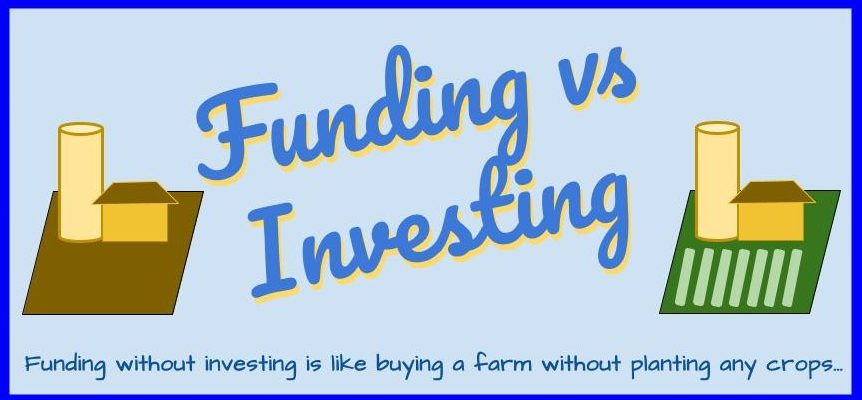
Although none of us are farmers, I think you will still understand this analogy. Opening an account is like buying a farm – it is just dirt until you plant your investment crops.
Most of the time, you move money into an account to open it – this is funding. Later you need to go back in and then start the investing process by talking to a broker or by using the brokerage website or app to make the purchases.
Future cash transfusions also need to be invested. Any future cash added to the account such as an annual contribution or a 401k rollover, will sit patiently in the account and wait for your purchase instructions to put the money to work.
There are exceptions. Some accounts are both the account and the investment:
- Certificates of deposit (CDs) can be opened at a bank and be a separate account
- Mutual funds when purchased directly from the mutual fund company will be both an account and an investment
- Real estate investments will each be a separate investment that is also technically an account since the property is registered with the county
Forgetting to Fund Costs Many Investors
Forgetting to invest funds is quite a common problem. Vanguard research discovered that millions of Americans may forget to invest 401K rollovers and even regular IRA contributions.
401K Rollovers Missed
Vanguard research found that 28% of IRA investors leave their 401K rollovers entirely in cash for seven or more years! That is more than one out of every four 401k rollover investors. With 27 million 401K rollover-funded IRA accounts in the USA, this suggests around 8 million affected account holders!
A thread on Reddit for this research backs up the possibility because most contributors admit to forgetting to invest their funds for days and even years. Vanguard estimates that forgetting to invest funds long term can cost an average 401k rollover investor over $130,000 in income.
Direct Contributions Missed
Direct contributions, or direct cash contributions to an IRA account, sit in cash for at least one year for 55% of account holders. More than half of the people surveyed forgot to invest their IRA funds after adding the funds to the account!
So since more than 57 million Americans have IRA accounts, this suggests more than 28 million Americans miss potential investment gains with their money sitting in cash.
Fifteen US states now offer auto-investing IRAs that don’t require investor action to move cash to a target date fund based on the age of the investor. While this makes investing easier, it doesn’t train that investor in the basic processes needed once they change their job and need to rollover the account. It also doesn’t help those that want a more aggressive or a more conservative investment option.
Easy to Fix
Fortunately, investing deposited funds isn’t hard, you just need to remember to do it. Make it easy on yourself and make at least a post-it note reminder with a date on it.
For the more tech savvy, set up a calendar notice (on your phone, etc.) to check the account a few days after you deposit your funds. It can take a few days to process checks or transfers, but once the brokerage shows the money in the account, you can start to invest it.
If you make a monthly or a yearly deposit to your IRA, make yourself a repeating reminder on your phone or your PC calendar to check the account and invest funds. You can also make it a habit to review your account status at the end of every month or quarter to see how the account is performing and then you can also catch dividends and interest that may not be automatically invested.
Deciding what to buy with your first deposit can be intimidating, but we have covered basic index funds and emergency funds so just start there. None of us are so rich we can afford to ignore the potential income from our retirement investments!