My father invests very differently than I do. He embraces the safety and security of US treasury bonds and purchases them directly as the majority of his investing.
I interviewed my father to draw upon over 40 years of his investing experience in US treasuries as a non-professional, or retail, investor – like us. Since 1985, he studied trends and developed strategies that helped him to realize returns close to stocks without the equivalent downside risk.
This column covers the basics such as what are US Treasuries, their importance, and investing basics. Then we’ll proceed to leverage my father’s experience to provide additional tips and strategies to include bonds into your portfolio.
What are US Treasuries?
US Treasuries represent standardized loans made from investors to the US government. Standardization creates specialized terms which make bonds comparable and tradable; however, the non-centralized bond market makes the different types of government issues less transparent for pricing than stocks, commodities or options.
Bond Terms
Some US treasury terms (maturity date, interest rate, etc.) apply to all loans and all treasury terms apply to other fixed-income investments such as municipal or corporate bonds.
- Face value refers to the amount of the loan or the bond that will be returned to the investor, typically $1,000 (the price of the bond may be above or below the face value)
- Issue date provides the date when the bond was first sold
- Maturity date defines the date when the bond will be paid back to the buyer
- Coupon is the term used for the official interest rate (%) paid by the bond
- Yield defines the return on the investment (%) based on the current sale price
Although this defines the basics, trying to buy bonds produces a new set of terms. For example, on the US Government direct sale website, Treasury Direct, one of the latest bonds sold (as of writing this in July) is described as a 10-year 4.375% note issued on 7/15/26 with a current price per $100 of $98.380297.
Some of the information we can match up immediately:
- Maturity = 7/15/2036
- Coupon = 4.375%
The bond is priced per $100, but if the face value was actually $1,000, the market price listed as $98.380297 means an actual price of $983.80297 per bond.
To calculate the yield, you can either do the math of adding up all of the interest payments, calculating the difference between the current price and the face value, and creating a percentage of gain that is then divided by the number of remaining years left on the bond… or you can just read the yield in the brokerage quote or use a bond calculator like I do. For our example, the 4.375% coupon selling at a discount from the full face value results in an effective yield of 4.58%.
Buying and Selling Treasuries Basics
Now that we understand the lingo, we can start to understand the basics of bond investing such as where to buy them, pricing trends, basic rules of thumb, fixed income advantages, and associated risks.
Where to Buy and Sell Bonds
Brokerages offer bonds from the brokerage itself or from other third parties. These bonds will almost always be $1,000 face value bonds with a minimum quantity to purchase. I have seen bond minimums (set in terms of face value) as low as $15k and as much as $200k.
Beginners often start with purchases directly from Treasury Direct because they have no minimums and because the face value can be as low as $100.00. However, you can’t sell bonds back to Treasury Direct, and it will be very difficult to sell non-standard bonds so consider such purchases as final.
If you want to get started without the hassles of buying bonds directly, you can look at fixed income mutual funds or index funds. For example, Vanguard offers a long-term treasury index fund available both as a mutual fund (VLGSX) and an index fund (VGLT).
Bond Prices
Treasury prices fluctuate depending upon the current interest rate available from the US treasury. Consider two scenarios in our current environment of 4.58% yields.
An older bond issued with a lower interest rate, say 2%, will trade at a steep discount that will push the overall yield into the neighborhood of 4.5% so it can be competitive with the currently available bonds. Likewise, a bond with a higher interest rate, say 5% will be selling at a premium to push its overall yield down closer to 4.5%.
Basic Rules of Thumb
My father advises two fundamental rules when purchasing bonds.
- Buy below face value
- Buy the highest yield that you can
Treasuries bought below par will always be paid at par so you at least get your money back plus the guaranteed difference between the price and the face value. By purchasing the highest available yield you will also maximize your return compared to other bonds currently available.
If for some reason, there are two bonds with the exact same yield but different interest rates, pick the bond with the highest coupon to be less sensitive to interest rate fluctuations. For example, a 1.5% interest rate bond selling at a steep discount to the face value looks attractive because it will be cheaper than a 4% bond with the same yield to maturity.
However, a 0.25% interest rate change by the Fed will, percentage wise, be a smaller difference for the 4% bond so it will change in price much less than the 1.5% bond. The higher interest rate provides more stability and the lower rates will show more interest rate sensitivity.
Bond Advantages for a Diversified Portfolio
Bonds are the “steady horse in the stable” of investing. They don’t drop that much in value, and when stocks drop, they do go up. This creates a hedge, or opposite performance opportunity against dropping stock prices – at least under most circumstances, there have been a few rare occasions where both stocks and bonds dropped in price.
By holding a portfolio of bonds, you can also take advantage of favorable changes in rates. If the bonds you hold rise in value, you can sell them early to make a profit and buy new bonds.
Assuming you reinvest dividends, Investopedia reports the historical average annual return for the S&P 500 Index to be 10.51%, and many stock-centric investors take that return for granted. However, my father likes to point out that in rolling 10-year periods since 1926, 7.4% of those decades show negative returns for the stock market.
The most recent poor decade wasn’t that long ago. If someone purchased $10,000 of a typical stock index fund (SPY, etc.) in early 2000 they would still have had less than $9,900 by the end of 2009.
Purchasing bonds provides a foundation of growth that helps a diversified portfolio to perform well in stock market downturns. Bonds also make regular payments that you can use to make other investments regardless of how the stock market is performing.
Bond Risks
Bonds may be very safe, but the brokerage market is murky. In fact, the Charles Schwab brokerage makes you agree to the disclaimer below prior to seeing quotes for bonds – but it will not remind you on future logins:
Bond Prices – In the bond market there is no centralized exchange or quotation service for most fixed income securities. Prices in the secondary market generally reflect activity by market participants or dealers linked to various trading systems. Bonds shown in or offered through the System may be available through other dealers at superior or inferior prices compared to those shown in the System. All prices are subject to change without prior notice.
Limited Liquidity – The availability of an active secondary market now or in the future for the Bonds shown in the System will impact your ability to sell your Bonds, whether at a profit, loss or at all. As with the trading of any security, the amount you receive in a sale may be more or less than the amount you invested.
What does this legal mumbo-jumbo mean?
- Unlike stocks (or options or commodities), there is no established and centralized market to establish prices
- The price you get will likely be different from the listed Bid (buyer) or Ask (seller) price
- The brokerage internal markup on the bond may not be fully disclosed or included in the commission.
- There is no guarantee you can sell a bond you buy, you may have to sell it for less than you bought it
Many of these also apply to stock purchases, but the commissions and price differences will be wider for bonds than for stocks.
Types of Treasuries
The five main types of US Treasury Bonds sold are Treasury Bills (T-Bills), Notes, Bonds, STRIPS, and TIPS. The table below provides a quick comparison before we go into more detail on each bond and current examples.
| T-Bills | Notes | Bonds | STRIPS | TIPS | |
| Maturity | 4-52 weeks | 2-10 years | 20-30 years | Any | 5, 10, or 30 years |
| Interest Payments | None | Every 6 months | Every 6 months | None | Every 6 months |
| Inflation adjusted | No | No | No | No | Yes |
| Liquidity | High | OK | Low | Low | Depends on the maturity |
| Interest rate sensitivity | Low | OK | High | Depends on the maturity | Depends on the maturity |
| Available from Treasury Direct | Yes | Yes | Yes | No | Yes |
This information can also be found on other public websites such as Investopedia or Fidelity, so if you are interested you can learn even more. When the liquidity or the interest rate sensitivity depends on the maturity, it means the longer the maturity, the more sensitive and the less liquid the Treasury will be.
T-Bills provide short term options of less than a year (4 to 52 weeks if purchased directly from Treasury Direct). The government sells the bond at below the face value and pays no interest, but will pay the full face value upon the redemption date.
Investors use T-Bills the way we can use short-term bank certificates of deposit (CDs) to obtain a higher rate of return for money we may need soon, but not right away. The US government is seen as safer than a bank and thus a better place to store cash.
An example of a T-Bill available at the time of this writing from a brokerage is: US Treasury Bill, maturity 10/20/2026, minimum 50 ($50,000), yield to maturity (YTM) 3.909%, price $99.1085 (or $991.085 per $1,000 face T-Bill).
Notes provide medium term loans with the security of fixed rate returns and are less vulnerable to interest rate fluctuations than long term bonds. The government pays interest twice a year on the anniversary of the issue date and six months from that date.
Example: 10-year treasury bond issued 8/15/2019, maturity 8/15/2029 (3 years from now), minimum 350 ($350,000), yield to maturity (YTM) 4.345%, price $92.30859 (or $923.0859 per $1,000 face bond), coupon 1.625%.
Bonds provide long-term guaranteed payments but they are quite vulnerable to changes in interest rates so they also offer higher rates to offset the risk. The government also pays interest payments every six months on treasury bonds.
Example: 30-year treasury bond issued 8/16/1999, maturity 8/15/2029 (3 years from now), minimum 300 ($300,000), yield to maturity (YTM) 4.315%, price $105.121 (or $1,051.21 per $1,000 face bond), coupon 6.125%.
Note that both the note and the bond examples actually only have 3 years left despite being issued earlier. You can always find the bond length you need, but these particular ones also have high minimums ($300k+) and very different prices because of their very different interest rate payments (coupons).
Investors use Notes and Bonds as mid-range investments similar to a multi-year CD investment. These fixed-rate investments also provide a hedge against stock market drops because they are seen as a safer alternative.
STRIPS, or Treasury Zeros, are special packaged bond created by brokerage companies that separate the interest payments and the principal and sell all of the components separately. The buyer can purchase the components at a discount, but receives no interest and obtains the full amount of the payment upon maturity.
For example, a five year treasury bond can be converted into 11 different STRIP Bonds. One STRIP for the face value and an additional STRIP for each of the 6 month interest payments.
Brokerages will bundle multiple STRIP interest payments together so the face value of redemption is $1,000.
Example: 30-year stripped treasury bond issued 5/15/2026, maturity 5/15/2056 (30 years from now), minimum 10 ($10,000 face or $2,217.60 – see the price coming up), yield to maturity (YTM) 5.119%, price $22.176 (or $221.76 per $1,000 face bond), with no coupon payments.
Strips allow for a large final payment with less investment up front. While a STRIP with three years remaining may be priced for $880, the 30 year STRIP above is priced under $250 for an investment basically guaranteed to pay $1000 in 30 years.
However, note that you will be expected to pay taxes annually on the increase in value of the STRIP, so these are best held in tax-shielded accounts. Also, only investors with a long time before they need their money should be purchasing STRIPS – at least the ones with maturity dates many years out.
TIPS (Treasury Inflation-Protected Securities) are treasury bills that can increase the interest payments based on the consumer price index increases (inflation) to eliminate some of the risks of fixed income investments. However, the inflation adjustment only happens twice per year and can lag the actual inflation rates.
An example of a TIPS available at the time of this writing: 10-year TIPS bond issued 7/15/2019, maturity 7/15/2029 (3 years from now), minimum 25 ($25,000 face), yield to maturity (YTM) 2.018%, price $94.936 (or $949.36 per $1,000 face bond), coupon 0.25%.
These bonds are discounted because they can adjust later to catch up to the current interest rates. But for now, their yield isn’t as high as other bonds because they are in demand by those who fear inflation.
Importance of US Treasuries
Economists and investors view US Treasuries as the ‘risk-free’ investment, or the safest investment you can buy. Although US government spending deficits adds future payment risk, and erodes this concept, no other currency or government has yet to replace the US treasury as the risk-free option so US treasuries remain in high demand.
For example, China holds $765 billion in US Treasury debt and Japan holds over $1 trillion in US treasury debt. However, even these amounts fall below the $1.7 billion of US Treasury debt held by state and local governments, the $973 billion inside pension funds, and the $4.4 trillion held in mutual funds.
Individual investors usually turn initially to banks to buy CDs. But eventually, we realize the banks are turning around and buying treasuries with our money, so perhaps we should cut out the middleman.
Investing Advantages to US Treasuries
US treasuries provide investors with two key benefits beyond basic bond benefits covered above::
- reduced risk because payments by the US government are close to guaranteed
- tax-reduced income because the redemption of the bond is simply return of capital and is non-taxable
While bonds can be purchased above or below face value, the interest payments and final redemption (payment upon maturity) will never be reduced.
Treasury interest is taxable, but there are exclusion amounts within some tax brackets, and some states (such as California) do not tax the interest on US Treasury bonds providing even greater tax advantages.
While corporate bonds provide some hedge and tax reduced income, they will be significantly more risky than US Treasuries. Municipal bonds may offer similar tax reductions, but even they cannot offer the same level of reduced risk because states, cities, and airports can’t print money to make payments. Additionally, the analysis of these other bonds categories will be significantly more complex and difficult because you will need to determine both their financial solvency as well as their capability to maintain their revenue to pay off the bonds.
Pro Bond Strategies and Tips
You can just buy a bond, but strategies can improve your results. First, time your purchase based upon expected interest rate changes and pick up discounted bonds opportunistically. Second, you can make regular purchases of bonds to create a steady stream of income using a technique called “Laddering.”
Timing Purchases
As with stocks, bond prices go up and down in price and, if you can be skilled, you can time the market to improve your profits. My father studies what the Federal Reserve and the US Treasury department publicize about the state of the economy and inflation to get a sense whether the Federal Reserve (the Fed) will be inclined to raise, drop, or hold rates steady.
An important tool to help predict the Fed’s behavior is the yield curve.
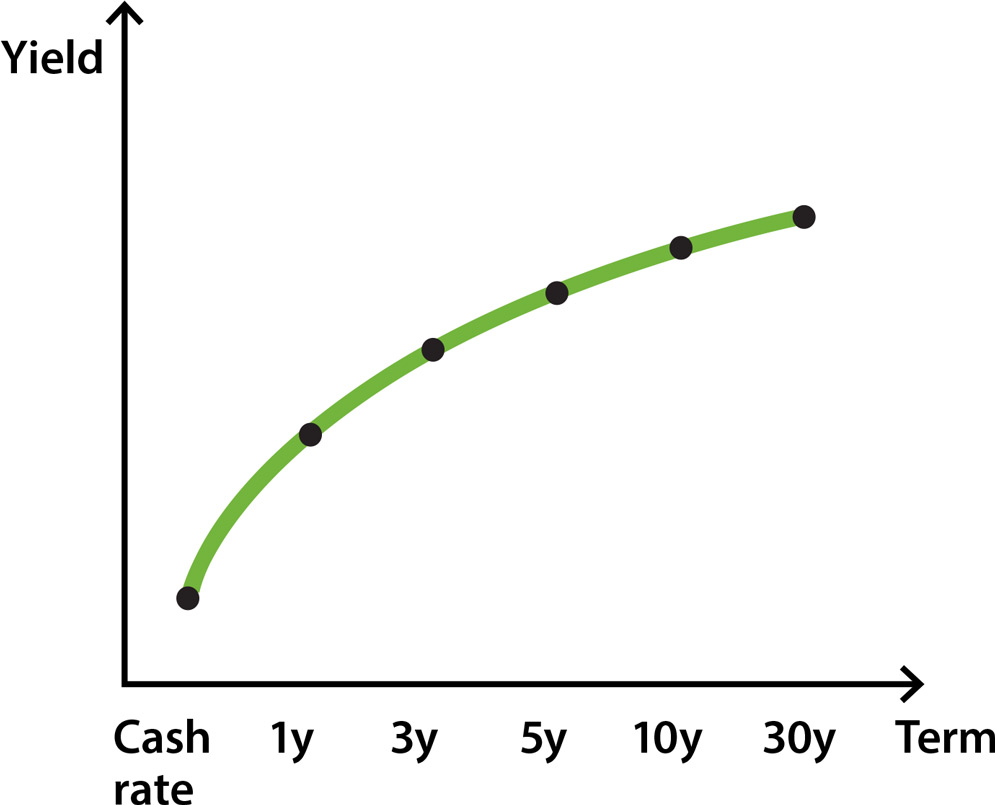
This graph from the Reserve Bank of Australia (the Australian Fed) illustrates, the typical yield curve will be lower for short term money and higher for long term money. People who lock in their money for 30 years take a larger risk for inflation and therefore need more compensation.
However, the yield curve can flatten or even invert:
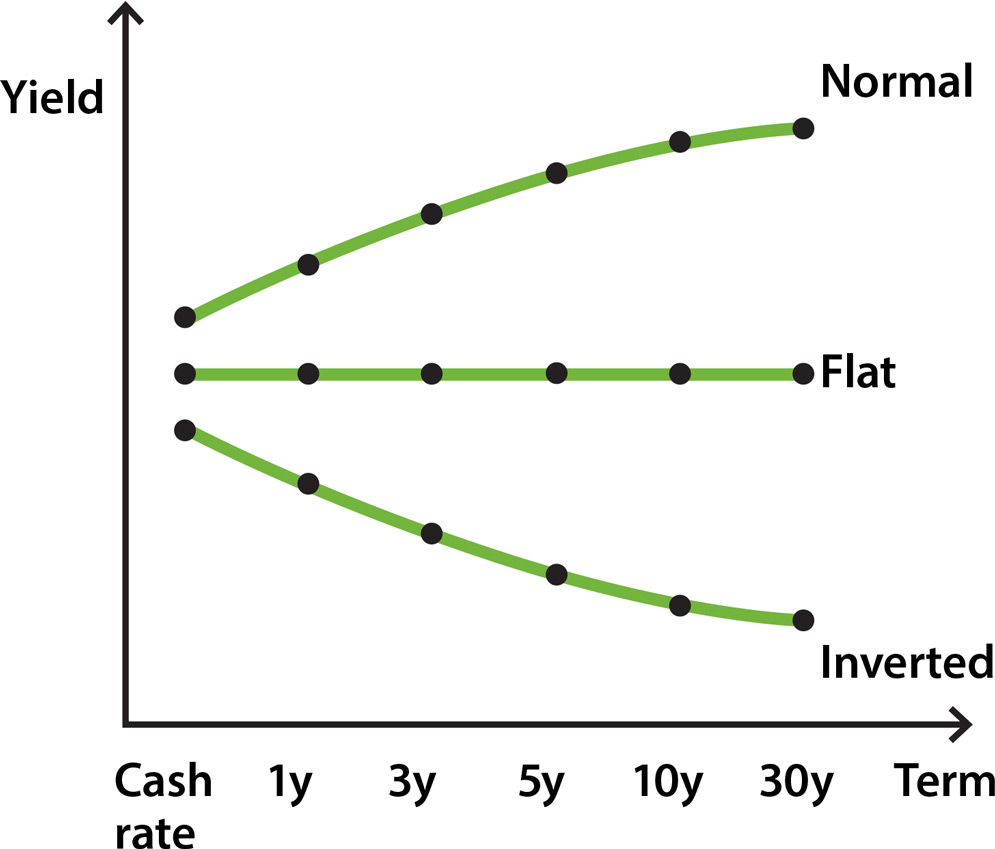
The flat rate implies uncertainty about future bond prices and expectations for a drop in interest rates. An inverted yield curve illustrates even stronger pricing pressure and is often associated with an economic downturn in the USA.
The curve moves as investors sell off the short term (low) rates which raises their yield. Investors then buy the long term bonds to lock in higher rates – which raises prices and drop the yield.
My father always looks for bonds priced just below par (usually around $980) to obtain a decent yield overall and look to pick up mid-range bonds around 10 years out. He also suggests monitoring treasury prices and trying ‘paper’ trades where you don’t use real money and just pretend you made the purchase. By paper trading for a year, you will get experience and a track record of your performance without any financial risk.
Laddering Strategy
Most of us work to receive steady income. You can also use a technique, called Laddering, to pay yourself a steady income. Laddering buys sequences of bonds (or CDs) that will pay out on a staggered interval.
In our example we’ll make an annual payment ladder, but it is also possible to create monthly and weekly ladders if you want to do the work. For now, consider saving $10,000 per year.
- Year 1: Save $10k and buy 5 year bonds (A)
- Year 2: Save $10k, buy new 5 year bonds (B), receive interest on bonds A
- Year 3: Save $10k, buy new 5 year bonds (C), receive interest on bonds A-B
- Year 4: Save $10k, buy new 5 year bonds (D), receive interest on bonds A-C
- Year 5: Save $10k, buy new 5 year bonds (E), receive interest on bonds A-D
- Year 6: Save $10k, receive the full value of Bond A, receive interest on bonds B-E, and buy at least $20k in 5 year bonds (F).
As you can see, starting in year 6, the bonds purchased five years earlier come due and allow for you to start doubling your purchase of future bonds. If you are buying below face value (say $950 per bond), then your $10k of bonds will only cost $9,500 and you have $500 extra to invest elsewhere or save as cash.
You can also either use the interest payments as fuel for other investments, or you can put the interest towards buying additional bonds (once you accumulate enough interest). At 3% interest, the bonds will only pay $300 a year on $10,000 face, however, that $300 + $500 not spent in year 1 + $500 not spent on bonds in year 2 (since you will buy below face value again), is easily enough to buy one additional bond.
If you decide to maximize your bond ladder this way you would have the following:
| $Bonds Bought (Actual $ Spent This Year) | #Bonds Bought | Leftover Cash | Total Face Value of Owned Bonds (All Purchase) | Annual Income | Matured Bonds Paid (Use to Buy Bonds) | |
| Year 1 | $9,500 | 10 | $500 | $10,000 | $300 | $0 |
| Year 2 | $10,450 | 11 | $350 | $21,000 | $630 | $0 |
| Year 3 | $10,450 | 11 | $530 | $32,000 | $960 | $0 |
| Year 4 | $11,400 | 12 | $90 | $44,000 | $1,320 | $0 |
| Year 5 | $11,400 | 12 | $10 | $56,000 | $1,680 | $0 |
| Year 6 | $20,900 | 22 | $790 | $68,000 | $2,040 | $10,000 |
| Year 7 | $23,750 | 25 | $80 | $82,000 | $2,460 | $11,000 |
So, in year 7, even though you’ve only put $70,000 into the account, you own $82,000 face value of bonds. In fact, if you keep investing $10k per year for 30 years ($300,000 total) and invest all extra cash and dividends into bonds (let’s assume this is in an IRA so taxes are not a problem), then in year 30:
| $Bonds Bought (Actual $ Spent This Year) | #Bonds Bought | Leftover Cash | Total Face Value of Owned Bonds (All Purchase) | Annual Income | Matured Bonds Paid (Use to Buy Bonds) | |
| Year 30 | $119,700 | 126 | $470 | $590,000 | $17,700 | $93,000 |
You will almost have doubled your money and generated annual income of $17,700 just buying 3% bonds below face value.
In a taxable account, the results will be similar, although reduced. Just keep in mind you only pay taxes on the 1) annual income provided from the bond interest and 2) the $500 difference between the redeemed face value and the original purchase price.
This is a simple model based on static assumptions (always $950 purchase price, always 3% interest, no taxes, always reinvesting everything, etc.). In real life, both the purchase price and the dividend rate will vary so the results won’t quite reach this level of predictability.
However, that means you also have opportunities to take advantage of changes in the interest rate to sell overpriced bonds and buy lower priced bonds. This might mean moving one rung of the ladder (no redemptions that year), but if you can grow a future rung of the ladder (or year of income) by 10% or 20% by moving it to a different year, then it can make sense.
Consider Buying Stability With Upside
My father started out buying 30 year bonds when interest rates hit 10% in the 80’s and enjoyed great success with both his timing and his laddering. Now, his time horizon has shortened to 5 and 10 year bonds because he doesn’t expect to live long enough to redeem 30 year bonds and because he’s less certain about the stability of the US Treasury.
However, he is confident enough to strongly recommend buying US Treasuries to all investors – especially his grandkids and their cousins. Treasuries provide investors with less risk, reduced tax exposure, and steady income that can’t be duplicated by other investments.
[…] option with CDs is to create a CD ladder similar to the bond ladder in the Treasury Bond Article that illustrates how $10k a year can grow to $590k in thirty years. The same math still works for […]