To make good investments, I try to make purchases that will be worth more to me in the future than they are worth to me right now. While this sounds very simple, it often will be complicated by exactly how to determine the worth, or value, of the investment.
Precise valuation requires effort, market analysis, and future economic forecasts, so many investors don’t do this work. Especially since the ‘precision’ of the analysis introduces assumptions that actually can make the valuation estimate less accurate.
Fortunately, basic and intermediate investors can perform broad, simple evaluations to create a rough, but useful estimate of evaluation. Even if you are tempted to rely upon experts through index funds or money managers, the easy concepts behind a basic valuation help evaluate the results of your hired experts.
In other words, my son-in-law, I know you just want to do index funds, but you should also understand this to some degree. After all, it will help you to understand the context and content of those funds.
Market Value
The easiest and most used measure of value comes from what other people will pay or the market value. The source of the market will depend upon the type of asset. For example:
- Stock prices will be determined by the stock market
- Eggs will be priced by both the commodity market and the local market
- Homes will be priced by the real estate market
- Fine art will be priced by the art market
Most businesses and insurance companies often use market prices as a proxy, or estimate, for the actual value of the investment. This removes personal feelings from the valuation and allows for a more universally accepted valuation.
Market Value Example 1: Eggs
Egg producers often sell to customers based upon contracts established in advance. However, some eggs will be produced outside of those contracts and sold on the commodity markets.
According to TradingEconomics.com, a graph of the price of eggs in US dollars over the past five years looks like this:
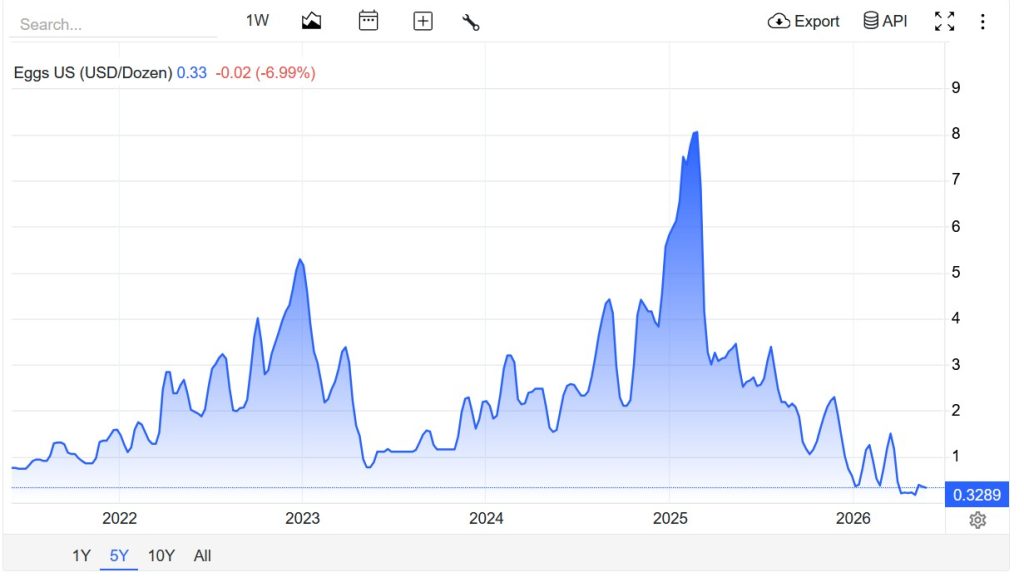
As we can see, the current price of eggs is around $0.33 per dozen eggs in late May 2026, but eggs have spiked to as high as $8 per dozen in 2025.
An imbalance of buyers and sellers causes these price fluctuations. As many buyers enter the market, the prices increase and when there are more eggs than buyers, the prices decrease.
Of course, the price you pay in the grocery store will be much higher because the grocery store must add in their own costs (transportation, storage, refrigeration, breakage, spoilage, employee labor costs, taxes, etc.) on top of the commodity price for the eggs. Thus, the commodity market price is related, but often much less than your retail market price for eggs.
Market Value Example 2: Canadian Solar (CSIQ)
Buying stocks will be much more clear than buying eggs. Typically all buyers purchase stocks from the same place- the stock market.
For example, Canadian Solar trades on the NASDAQ stock exchange under the four-letter stock symbol, CSIQ. While brokerage companies have the option to fulfill orders internally or trade with other stock holders, everyone uses the centralized market clearing house of the NASDAQ exchange to determine the prices.
On May 26, 2026 CSIQ stock began trading at $19.30 (opening price), went as high as $20.02 (interday high), and dropped as low as $18.76 (interday low) before ending the day at $18.93 (closing price). Over 3.7 million shares of the company changed hands and the number of buyers and sellers shifted the price up and down.
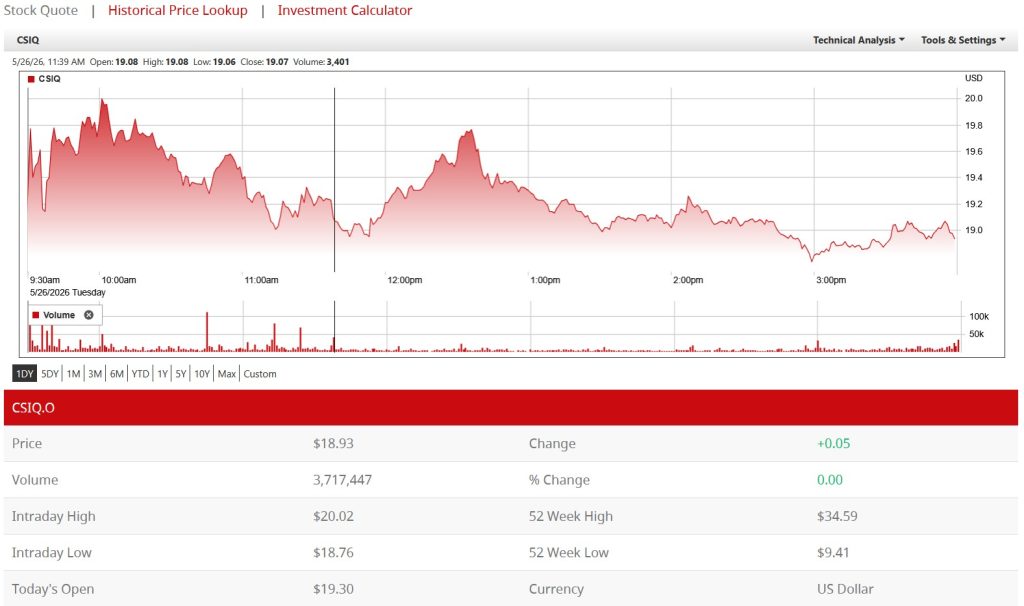
The daily shift in opinion of individual buyers and sellers leads to different personal valuations of the stock and the market determines the value of the stock based upon the balance of the buyers and sellers. When buyers and sellers are unbalanced, the price will move a great deal.
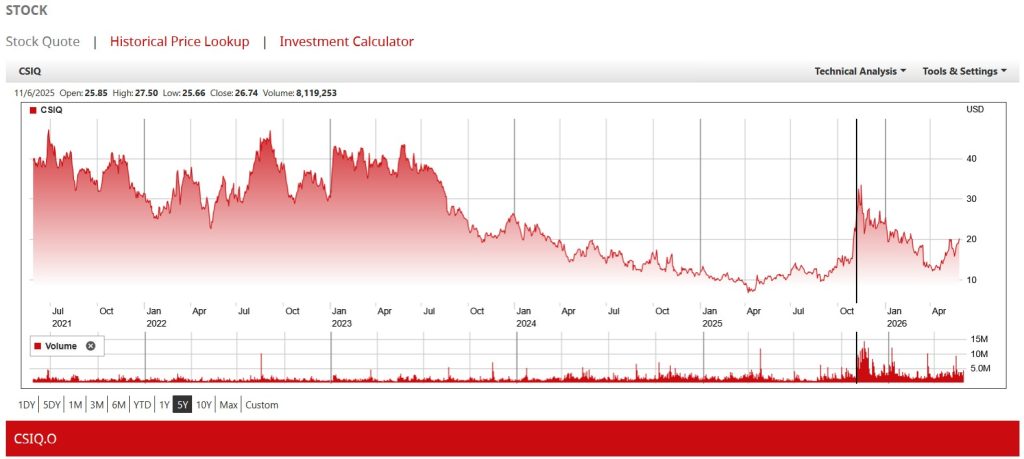
For example, in the 5 year chart, we saw big price increases in late 2025 as the number of buyers greatly exceeded the number of sellers. While the stock slowly dropped afterwards, the price could move up or down quickly with a similar imbalance.
Market Value Shortcomings
While useful as an estimate, market value may not capture the actual value. The imbalance of buyers and sellers may stem from optimism and pessimism surrounding the investment rather than the actual value.
Market value can also be manipulated. 2026 provides an excellent example of oil producing countries trying to limit price declines by limiting supply of oil followed by military actions that further caused prices to soar.
Lastly, the market size also can lead to extreme changes in value. For example, the limited supply of collectibles such as comic books or art and the smaller number of interested buyers can lead to significant differences between estimated value and the actual price an item will generate in an auction.
Inherent Value
The inherent value of an asset can be different from the market value. What people will pay on any given day determines the market price.
The inherent value, or the “true” value of the investment may be higher or lower based upon your expectations for the future. If you see great things ahead for your investment, the market price may be below your expectations for the inherent value. If you see trouble ahead, the market price may be above your expectations.
Market Versus Inherent Value Example: Used Car
The easiest example is to consider a used car. A skilled buyer can talk a seller into a discount and create a market value below the actual value of the car.
Of course, both the buyer and seller of the car will negotiate not only based on the perceived value of the car now, but their expectations of future worth and utility. By putting the car up for sale, the seller admits that they don’t need the car or that the car will have declining value to them going forward.
Similarly, by seeking to purchase the car, the buyer admits that the car will have value for them in the future. Whether or not the transmission on the car fails in the first year after purchase can greatly affect not only the potential gap between the market price (purchase price) and the inherent value of that car, but if the buyer or the seller was more accurate regarding the value.
Mr. Market is a Drunk
Market prices for commodities, currencies, and stocks rise and fall based upon the optimism of the majority of the people. However, many experienced investors caution against putting too much weight into the current market price or price trends.
The famous investor Warren Buffett, CEO of Berkshire Hathaway for 55 years, summarized the market price as the whims of Mr. Market. “This imaginary person out there — Mr. Market — he’s kind of a drunken psycho. Some days he gets very enthused, some days he gets very depressed. And when he get really enthused, you sell to him and if he gets depressed you buy from him. There’s no moral taint attached to that.”
Buffett’s mentor, Benjamin Graham wrote in his book, The Intelligent Investor that “The stock investor is neither right or wrong because others agreed or disagreed with him; he is right because his facts and analysis are right.” Graham urges investors to evaluate the financial health of the stock based upon the company’s finances and an evaluation of the market for their products or services.
Public companies, such as CSIQ, must publish regular financial reports that cover:
- Balance Sheet: the current value of what they own and what they owe
- Income: the amount of money earned from doing business, the costs associated with those sales, and the net accounting profits or losses.
- Cash Flow: the amount of cash generated and used by the business, investment activities, and financing activities.
The current value of the business, also known as enterprise value, can be pulled from the balance sheet. The trends of sales and expenses in the income sheet and cash flow statements imply a health for the company to project the value of the business and expectations for the value of the business in the future.
Together, the current and future values combine to suggest an appropriate actual, or inherent value for the company. Typically differences of opinion for the future value of the company create the price movements and differences between the enterprise value and market values of the company.
Let’s look at two extreme examples that illustrate optimism and pessimism.
Optimistic Valuation Example: SpaceX
Space Exploration Technologies Corp., better known as SpaceX, recently filed their S1 form with the US Securities and Exchange Commission (SEC) to release stock to the public market through the NASDAQ stock exchange. SpaceX failed to disclose the exact number of shares to be released to the public, but financial press sources such as Yahoo!Finance estimate the market value (stock price times the number of shares) to hit $1.7 trillion dollars ($1,700,000,000,000).
Is this a reasonable valuation?
On page 23 of the S1 filing, the Balance Sheet shows total assets for the company of $102 billion dollars and $60 billion in debt (loans, bonds, etc.) for a net of $42 billion of value available to the shareholders. That’s a lot of money, but there is still $1.699 trillion of value we do not see in the hard numbers.
On page 21 of the S1 filing, we find revenue (basically, sales of rocket access and Starlink) of $4.7 billion and, after accounting for costs, a loss of $4.3 billion. Value comes from profit, so essentially, the missing $1.699 trillion of missing value represents the belief from potential investors that not only will the company start to make money, but they will make so much money that it is worth paying 340 times the current annual sales!
Very optimistic indeed.
Pessimistic Valuation Example: Canadian Solar
For better or worse, Canadian Solar represents the pessimistic perspective. In their 6K filing with the SEC, their balance sheet on page 11 (page 15 of the PDF) lists a total asset value of $15.5 billion dollars including $1.86 billion in cash equivalents and $11.2 billion in various debts.
This shows $4 billion dollars of value available to shareholders.
On the income statement on page 9 (page 13 of the PDF), CSIQ shows sales of $1.1 billion and a net loss of $13.5 million dollars.
With 67.8 million shares of stock released and a current share price (as of 5/29/2026) of $20.26, the stock market currently values the company at $1.4 billion dollars… or less than one fourth of the value indicated by their balance sheet! In fact, this is valued at less than CSIQ’s cash!
The stock market seems to think that CSIQ will do so poorly that they will never make money, continue to lose money annually to destroy the current assets of the business, and be worth less than their cash currently in the bank.
SpaceX loses over 300 times as much money as CSIQ yet will be valued as 1,000 CSIQ’s. A very pessimistic valuation for CSIQ, indeed!
Other Types of Valuation
There are other types of valuation that can and should be used when appropriate. Four common valuations are book value, usable value, personal value, and context value.
Book Value
Book value is what you paid for a specific asset. For example, if you buy a stock for $100, you have a stock you valued at $100 and it remains a $100 asset until you sell it. It doesn’t matter if the stock goes up to $1,000 or drops to $1, as long as you don’t sell it, your book value is $100.
Usable Value
The usable value, sometimes called the utilitarian value, of an asset reflects your ability to use the specific asset. For example, no matter how much value uranium may have for a nuclear reactor or as a commodity, a chef won’t be able to use it to help their restaurant.
Personal Value
The personal value of an item may exceed or fall below other forms of valuation for the item. For example, a concert t-shirt for your favorite band will be worth much more to you than the same-cost shirt for a band you hate.
Context Value
Context value, called marginal utility by economists, considers the value of something in relation to your need. For example, consider a pepperoni pizza under the following conditions:
- Hungry college students value pizza highly
- Vegetarian college students will have no use for a pepperoni pizza
- Stuffed college students that already ate 12 pepperoni pizzas don’t want more pizza and the value of additional pizzas continues to decline (a diminishing return).
How to Invest Using Valuation
Finance classes in college teach sophisticated valuation techniques to value an enterprise. This level of effort may pay off for the professionals and the most sophisticated investors, but probably will be overkill for the beginner or intermediate investor.
Yet some effort can provide valuable insight. You can start by looking at the stock price. The charts like we have above for commodity eggs and CSIQ shows the recent trends in buyer and seller sentiments. This can hint if the majority of people are optimistic or pessimistic about the asset’s future.
The Basic Steps For Simple Valuation
For stocks, you can also look at the basic finances and determine how much premium or discount the market has priced into the stock. Consider the optimistic and pessimistic examples above.
We examined the public information about the company assets found on the balance sheet, compared it against liabilities to determine the value of what the company owns. Next, we considered the sales and profitability found on the income statement and we could also compare against previous years to determine the trends for the company’s performance to understand the company’s future.
Lastly, we examined the market capitalization of the stock, or the price per share times the number of shares available (found on the income statement). You can do this math yourself or look on a site such as Yahoo!Finance for the market capitalization number.
Once you have all of these numbers, compare them to see what makes sense. Remember, that a great company might be a bad value, depending on the price.
Example Valuation Conclusions
In the examples above, CSIQ has been losing money for the past few years, but they have cut their losses significantly in the last couple of years. This is a positive trend not reflected in the stock price which could indicate a stronger value than the market price.
I look at the SpaceX valuation and it seems outrageous to me. Yes, it is possible for the company to grow enormously, but the current finances suggest their spending is out of control in pursuit of their AI platform. SpaceX already dominates rocket launch and enjoys weak competition for their Starlink program, so I don’t see the room to grow 340 times bigger for these businesses plus AI (and X/Twitter). This seems overvalued to me…
Mr. Market’s Breathalyzer Test
Generating your own valuation will be more effort than simply looking at the market price. Yet, doing a little homework can provide valuable context to determine how drunk Mr. Market may be with regards to the specific investment.
This process becomes more difficult for assets such as real estate, bonds, commodities, or index funds which contain many different stocks. However, it never hurts to look at the recent trends or to dig a bit deeper to look under the hood to see if you can tell if the potential investment, or used car, is being overpriced.
[…] we covered last week in Basic Investment Valuation, the market price of any investment may differ from the underlying value of the investment. Funds […]